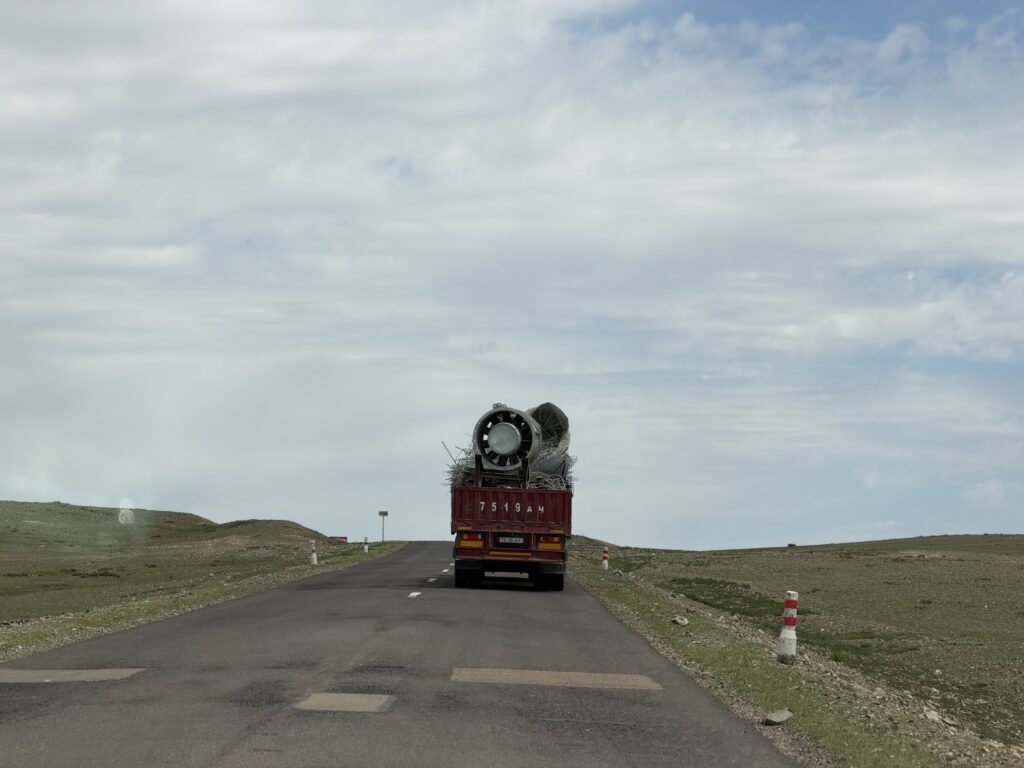
One of the things that caught my attention while traveling on Mongolia’s roads was the way drivers use their turn signals while passing.
On a long two-lane road, I would see the vehicle in front turn on a blinker even though it was not about to turn. It took me a while to understand that the signal was meant for the driver behind it: a small piece of road-to-road communication about whether the way ahead looked clear enough to pass.
Why passing is awkward in Mongolia
Mongolia drives on the right, so vehicles pass on the left. But many of the cars on the road are Japanese imports, especially Toyota Priuses, and are right-hand drive. I wrote earlier about why there are so many Toyota Priuses in Mongolia.
That combination puts the driver of a right-hand-drive Prius on the far side of the car from the center line. When following a truck, bus, or another car, it can be hard to see far enough into the oncoming lane to decide whether a pass is safe. The driver has to edge left for a look—the very maneuver that can make passing riskier.
The blinkers become a shared signal
Drivers have developed a practical convention. The vehicle in front may use its signals to communicate what it can see farther up the road:
- Left signal: do not pass; it is not safe to pull into the oncoming lane.
- Right signal: the road ahead appears clear, so it may be possible to pass.
The official rule is clear about the left signal: it warns that passing would be dangerous. The corresponding right signal appears to be an informal countryside convention, described by Mongolia driving guides and local drivers as meaning that the road ahead looks clear enough to pass. It is still not permission or a guarantee.
A solution shaped by the cars on the road
I like this little detail because it is such a visible example of people adapting to the vehicles and conditions around them. Imported right-hand-drive cars are not especially well suited to a country that drives on the right, but Mongolia’s drivers have found a simple way to share a bit more visibility when it matters.
It is easy for a visitor to mistake a blinking turn signal for an upcoming turn. On a two-lane Mongolian road, it may be part of an entirely different conversation.