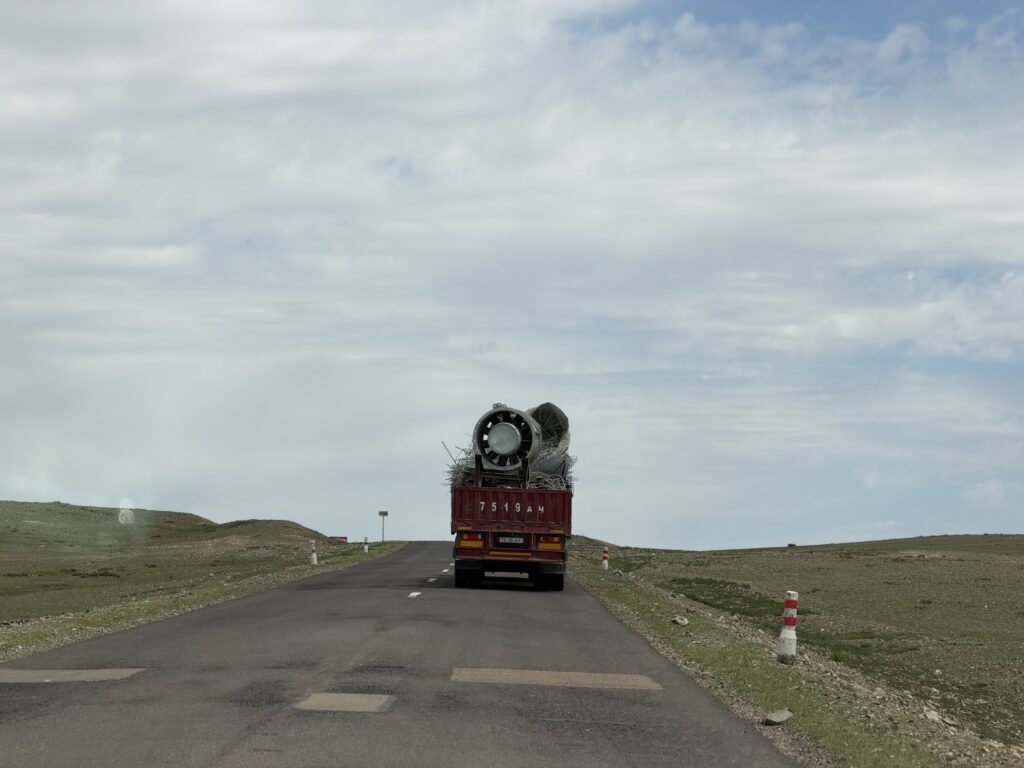
One of the things that caught my attention while traveling on Mongolia’s roads was the way drivers use their turn signals while passing.
On a long two-lane road, I would see the vehicle in front turn on a blinker even though it was not about to turn. It took me a while to understand that the signal was meant for the driver behind it: a small piece of road-to-road communication about whether the way ahead looked clear enough to pass.
Why passing is awkward in Mongolia
Mongolia drives on the right, so vehicles pass on the left. But many of the cars on the road are Japanese imports, especially Toyota Priuses, and are right-hand drive. I wrote earlier about why there are so many Toyota Priuses in Mongolia.
That combination puts the driver of a right-hand-drive Prius on the far side of the car from the center line. When following a truck, bus, or another car, it can be hard to see far enough into the oncoming lane to decide whether a pass is safe. The driver has to edge left for a look—the very maneuver that can make passing riskier.
The blinkers become a shared signal
Drivers have developed a practical convention. The vehicle in front may use its signals to communicate what it can see farther up the road:
Left signal: do not pass; it is not safe to pull into the oncoming lane.
Right signal: the road ahead appears clear, so it may be possible to pass.
The official rule is clear about the left signal: it warns that passing would be dangerous. The corresponding right signal appears to be an informal countryside convention, described by Mongolia driving guides and local drivers as meaning that the road ahead looks clear enough to pass. It is still not permission or a guarantee.
A solution shaped by the cars on the road
I like this little detail because it is such a visible example of people adapting to the vehicles and conditions around them. Imported right-hand-drive cars are not especially well suited to a country that drives on the right, but Mongolia’s drivers have found a simple way to share a bit more visibility when it matters.
It is easy for a visitor to mistake a blinking turn signal for an upcoming turn. On a two-lane Mongolian road, it may be part of an entirely different conversation.
One of the first things I noticed in Ulaanbaatar was the number of Toyota Priuses.
They were everywhere: parked along side streets, inching through traffic, working as taxis, and heading out of the city. Mostly second- and third-generation models, they seemed almost as common as the pickup trucks and rugged four-wheel-drive vehicles I had expected to see.
A low-slung Japanese hybrid might seem like an unlikely national car for a country known for bitter winters, rough roads, and enormous distances. But the more I learned—and the farther we traveled—the more Mongolia’s affection for the Prius made sense.
Almost half of recent imports
The numbers are remarkable.
Between January 1 and March 25, 2024, Toyota Priuses imported from Japan accounted for 47 percent of the vehicles Mongolia imported.
In April 2026, CNA reported that, according to Mongolia’s Ministry of Road and Transport Development, hybrids represented about 45 percent of the country’s roughly 1.5 million vehicles. The vast majority of those hybrids were Priuses.
This is not simply a case of one model selling particularly well. Mongolia has built an entire automotive ecosystem around the Prius.
Why Japan sells so many used cars
It is sometimes said that cars in Japan must be taken off the road after a certain number of years. That is not quite true.
Japan does not impose a maximum age on cars. Owners can keep a vehicle indefinitely as long as it remains registered, properly maintained, and able to pass the country’s vehicle-inspection system, known as shaken.
A new private passenger car receives an inspection certificate valid for three years. After that, it must be renewed every two years. Renewal involves the inspection itself, compulsory insurance, weight tax, and any maintenance or repairs required for the car to pass.
The inspection does not automatically condemn an older car. The issue is economic. As a car ages, its resale value falls while the cost of keeping it registered can rise. An OECD report found that Japanese ownership costs for conventional vehicles increase after 13 years, with higher road and inspection-related charges intended partly to encourage the adoption of newer, more efficient cars.
At some point, an owner may be facing a new round of inspection fees and repairs on a car worth relatively little in Japan. Replacing it often makes more financial sense than keeping it.
That does not mean the car has reached the end of its useful life. It has simply reached the end of its economically attractive life in Japan.
Japan consequently has an enormous used-car export industry. In 2025, it exported approximately 1.49 million used passenger vehicles to countries around the world. Mongolia receives only a portion of them, but it has become an especially important destination for used Priuses.
From a Japanese auction to Mongolia
Many of Mongolia’s Priuses are purchased through Japan’s large vehicle-auction system.
A World Bank-supported study of transportation in Mongolia describes a surprisingly complicated journey. Importers buy cars at physical or online auctions in Japan. Logistics companies move them to a Japanese seaport, where they are loaded into shipping containers—often four or five cars at a time.
The containers travel by sea to Tianjin, China. After being processed there, they continue by rail to the Mongolian border at Zamiin-Uud and eventually make their way to Ulaanbaatar and dealers around the country.
The Prius trade is large enough to include mass wholesalers importing thousands of cars per year. By the time one appears for sale in Mongolia, it may have passed through a Japanese auction house, a port, a container ship, Chinese customs, and a transcontinental railway journey.
Why the economics work in Mongolia
Fuel economy is a major part of the appeal.
Fuel costs are a major part of the appeal, and Ulaanbaatar traffic provides exactly the kind of slow, stop-and-go driving in which a hybrid works well. A recent study of electric mobility in Mongolia estimated fuel consumption of about 5.7 liters per 100 kilometers for a Prius 20-series—the second-generation model—compared with approximately 11 liters for the conventional Toyota Corolla used in the same comparison.
For years, Mongolia’s tax policies also favored hybrids over comparable gasoline-powered cars. Although some of the original exemptions have since been reduced, importing a small-engine hybrid remains relatively attractive.
The cars themselves are inexpensive because they arrive used. And because there are so many Priuses in Mongolia, parts are widely available and mechanics have become highly experienced at repairing them—including diagnosing and rebuilding their aging battery packs.
That creates a cycle: a common car is easier and cheaper to repair, which makes it more attractive to the next buyer, which puts even more of them on the road.
Adapted for Mongolian roads
A surprising number of the Priuses we saw appeared to have been modified for Mongolia.
Many sat noticeably higher than a stock Prius. Others had larger or more aggressive-looking tires, presumably to gain a little more ground clearance and traction on dirt roads. Some carried roof racks, spare tires, or other equipment that would have looked more natural on an SUV.
I couldn’t find any statistics showing how many Mongolian Priuses are modified, but it was common enough to be noticeable.
Lifting one of the second- or third-generation Priuses common in Mongolia does not turn it into a four-wheel-drive vehicle. Those models remain front-wheel-drive cars with limited suspension travel and vulnerable components underneath. Larger tires and extra ground clearance can nevertheless make them more practical on rutted roads, where the biggest problem may be avoiding rocks or keeping the center of the road from scraping the bottom of the car.
Owners seem to adapt the Prius just enough to make it work.
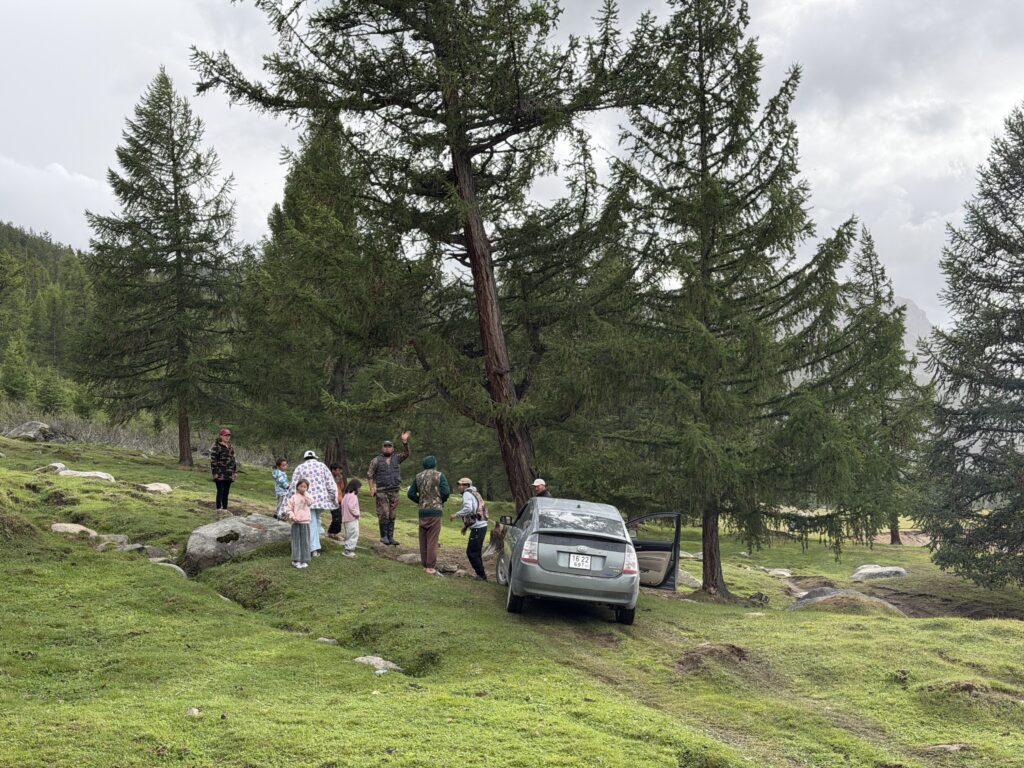
The Prius that joined a four-wheel-drive caravan
One day while we were camping, a large caravan of vehicles came through. Nearly all of them were four-wheel drives—the kind of vehicles you would expect to see traveling through that terrain.
But there was also a Prius.
The route included a steep, technical section covered in large rocks. Even the four-wheel-drive vehicles had a difficult time getting through it. Then it was the Prius’s turn.
It obviously could not make the climb on its first attempt. But the driver kept trying.
For close to 30 minutes, the Prius attempted different lines up the rocky section. It would move forward, lose traction or run out of clearance, and try again. Eventually, all of us walked over to help.
With a group of people pushing—and presumably with the driver wondering whether bringing a Prius had been a good idea—we managed to get it up and over the rocks.
The remarkable part was not that the Prius struggled. The obstacle had challenged actual four-wheel-drive vehicles. The remarkable part was that the Prius was there at all—and that its driver fully expected it to try.
By that point in the trip, perhaps we should not have been surprised. In Mongolia, a Prius is apparently allowed to join the caravan.
More capable than it looks
The Prius was designed as an efficient city car, not an off-road vehicle. Mongolia does not appear to have received that message.
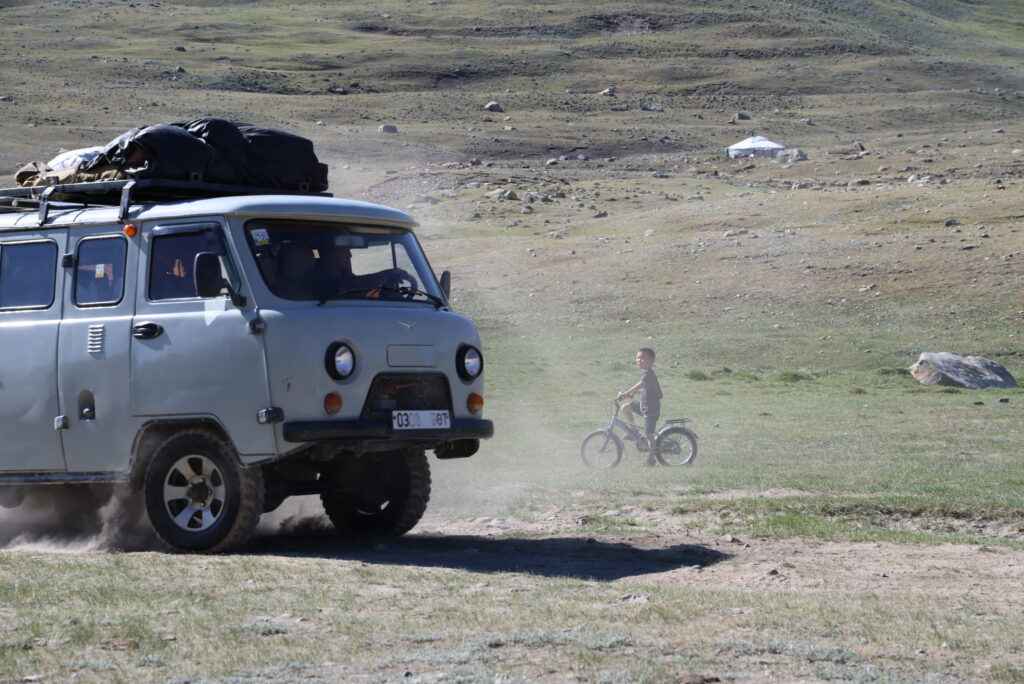
Priuses can be found far beyond Ulaanbaatar, traveling roads that would make many owners elsewhere turn around. They are not substitutes for the Land Cruisers, Russian vans, and other four-wheel-drive vehicles used for the most difficult terrain.
But the Prius is cheap enough, efficient enough, and apparently tough enough to go much farther than its designers probably imagined.
Its popularity also gives owners a certain freedom to experiment. If parts and knowledgeable mechanics are available almost everywhere, taking an old Prius down a rough road becomes less intimidating than doing the same thing in a rare or expensive vehicle.
Under the current policy, green plates are reserved for battery-electric vehicles and range-extended electric vehicles. An ordinary Prius is a gasoline-electric hybrid, not a battery-electric vehicle, and does not qualify. Plug-in hybrids are also excluded and continue to receive regular white plates.
With so many Priuses on the road, a green plate is a useful distinction. It identifies a vehicle in Mongolia’s electric category, not simply one of its hundreds of thousands of hybrids.
The battery problem
The Prius boom also has a downside.
Many cars arrive in Mongolia after years of use in Japan. Some are sold after their original battery warranty or service coverage has expired, when replacing a complete battery pack would be difficult to justify in the Japanese market.
Mongolia’s repair industry has become remarkably resourceful. Mechanics open the nickel-metal-hydride battery packs, test their individual modules, and replace the ones that have failed. Usable modules from several old batteries can be combined to keep another Prius on the road.
Eventually, however, the modules can no longer be reused.
My daughter had heard that there was a large warehouse full of discarded Prius batteries in Ulaanbaatar. A recent investigation suggests that story was substantially true—although “warehouse” may be too formal a word for it.
In April 2026, CNA visited an anonymous vehicle-repair garage on the outskirts of the city that had become an unofficial center of Mongolia’s depleted Prius-battery network. The owner, whose name was withheld, claimed that he collected nearly every dead Prius battery from Ulaanbaatar and beyond.
At the time of CNA’s visit, the owner said he was storing approximately 50,000 depleted Prius battery packs, reportedly accumulated since the beginning of 2025.
The number is the owner’s estimate rather than a verified government count. But researchers have independently documented an informal network of collection points around Ulaanbaatar where end-of-life automotive batteries are bought and stored. There are no national standards governing how hybrid batteries should be inspected, stored, or processed.
The garage owner had previously collected batteries for export and recycling in Japan. According to CNA, that route became blocked in early 2025 by new legal restrictions and rules preventing hazardous material from being transported through Mongolia’s neighboring countries. The batteries continued arriving, but they could no longer leave.
Mongolia opened its first dedicated lead-acid battery recycling plant in 2024. That is useful for the conventional 12-volt batteries found in nearly every car, but the plant cannot process the high-voltage nickel-metal-hydride packs used by older Priuses. Those require different equipment and procedures.
The reported stockpile is therefore not a recycling facility. It is the physical result of a system with a way to import hybrid cars, repair their batteries, and collect the depleted parts—but no completed final step.
The Prius helped make fuel-efficient transportation affordable in Mongolia. But when Japan exports the useful second life of a hybrid car, responsibility for the end of that life travels with it. Mongolia receives both the car and the battery that will eventually need somewhere to go.
Mongolia’s unofficial national car
Before visiting Mongolia, I associated the Prius with commuting, paved streets, and carefully calculated fuel economy.
Now I also associate it with Ulaanbaatar traffic, Japanese auction stickers, raised suspensions, oversized tires, dusty tracks—and a group of people pushing one over rocks while a convoy of four-wheel-drive vehicles waited.
The Toyota Prius may not be Mongolia’s official national car. But judging by the roads, it has a convincing claim to the title.
One of the small things I started noticing while traveling around Mongolia was that vehicle license plates came in several different colors. Most were white, but we also passed cars and buses with yellow, dark blue, red, green, and black plates.
The colors are not decorative. In Mongolia, the background color tells you what kind of vehicle you are looking at—or who owns it.
The quick guide
Plate color
What it means
⚪ White
Regular vehicles
🟡 Yellow
Public passenger transportation, including buses and taxis
🔵 Dark blue
Vehicles owned by the national or local government
🔴 Red
Diplomatic vehicles
🟢 Green
Qualifying electric vehicles
⚫ Black
Specialized technological-purpose vehicles
White: regular vehicles
White plates with black characters are the standard plates seen on most cars, motorcycles, and trailers. Calling these “private” plates is close, but “regular” is more accurate: the category covers ordinary vehicles that do not belong to one of the special groups.
A typical plate contains four numbers followed by three Cyrillic letters. On the plates we saw, the first two letters identified the registration area. Several combinations—including УБ, УН, УА, УЕ, and УК—were used for Ulaanbaatar. БӨ identified Bayan-Ölgii, ХӨ Khövsgöl, and ӨМ Ömnögovi.
Modern plates also carry two small national identifiers: Mongolia’s red Soyombo symbol on the left and an oval MNG mark between the numbers and letters.
Yellow: buses and taxis
Yellow plates with black characters identify vehicles used for public passenger transportation. That includes city and intercity buses as well as licensed taxis.
The distinction is narrower than simply “commercial vehicle.” A business-owned car or an ordinary cargo truck does not automatically receive a yellow plate merely because it is used commercially.
Mongolia’s vehicle-registration rules even account for a vehicle entering or leaving public passenger service: it can keep the same number and letter sequence while exchanging the yellow plate for a regular one.
Dark blue: government-owned vehicles
Dark blue plates with white characters identify vehicles registered as property of the national or a local government.
Mongolia began changing these vehicles to dark blue plates in 2023. The stated idea was to make publicly owned vehicles easier for everyone to recognize, discourage their use for personal errands, and improve public oversight.
This makes the color more than an administrative classification. It lets anyone standing on a street see when a vehicle belongs to the government.
Red: diplomatic vehicles
Red plates with white characters belong to diplomatic missions and qualifying diplomatic personnel. These plates use the Cyrillic prefix ДК, followed by four numbers.
The first pair of numbers can identify the country or organization. For example, published lists have used 19 for the United States and 32 for the European Union.
Green: electric vehicles
Green plates with white characters identify qualifying electric vehicles.
This category was particularly timely during our trip. In May 2026, Mongolia’s Ministry of Road and Transport clarified that green plates would be issued to battery-electric vehicles and range-extended electric vehicles. Conventional hybrids and plug-in hybrids do not qualify under that policy. The ministry specifically named common Japanese imports such as the Toyota Prius and Aqua as vehicles that would not receive green plates merely for being hybrids.
Qualifying green-plate vehicles are also exempt from Ulaanbaatar’s license-plate-based driving restrictions, giving drivers another reason to choose an electric vehicle.
Black: technological-purpose vehicles
Black plates with white characters are used for specialized technological-purpose vehicles and machinery.
Some informal explanations describe every black Mongolian plate as military, but that is not accurate. Mongolia’s civilian plate standard assigns black to the technological category, while vehicles used by the armed forces, border troops, and internal troops are governed separately.
A small system hiding in plain sight
Before learning what the colors meant, I saw them as just another unfamiliar detail. Once I understood the system, traffic became a little more readable. A yellow plate was carrying passengers. A dark blue plate belonged to the government. A red one was connected to a diplomatic mission. A green one was in the qualifying electric-vehicle category—not just one of Ulaanbaatar’s many imported Priuses.
It is a simple visual language, and once you know it is there, you start reading it everywhere you go.