One of the small things I started noticing while traveling around Mongolia was that vehicle license plates came in several different colors. Most were white, but we also passed cars and buses with yellow, dark blue, red, green, and black plates.
The colors are not decorative. In Mongolia, the background color tells you what kind of vehicle you are looking at—or who owns it.
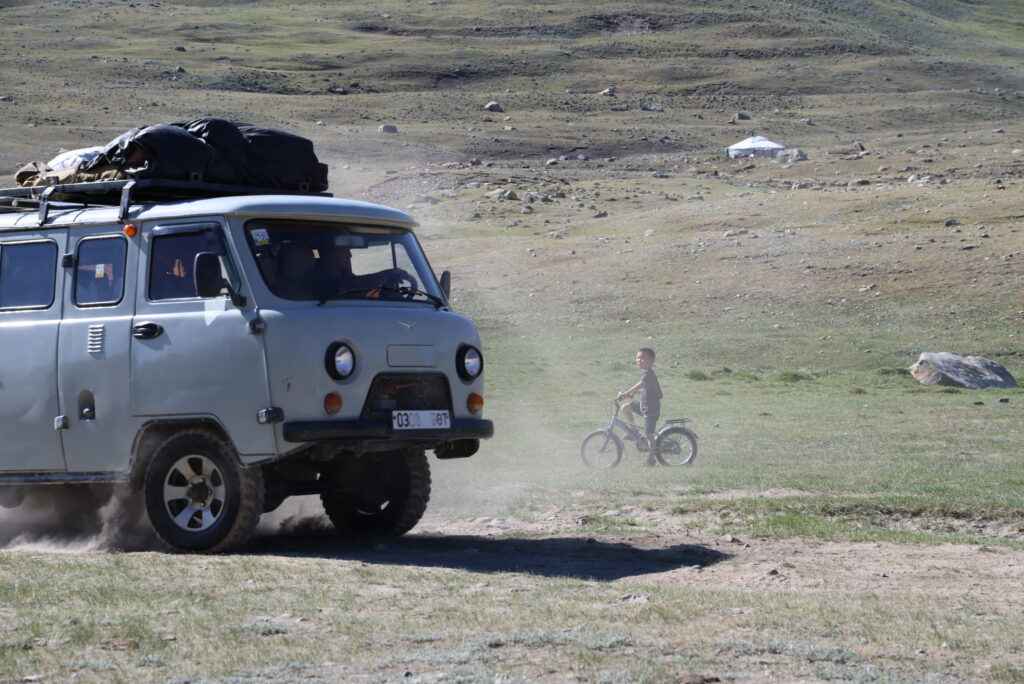
The quick guide
| Plate color | What it means |
|---|---|
| ⚪ White | Regular vehicles |
| 🟡 Yellow | Public passenger transportation, including buses and taxis |
| 🔵 Dark blue | Vehicles owned by the national or local government |
| 🔴 Red | Diplomatic vehicles |
| 🟢 Green | Qualifying electric vehicles |
| ⚫ Black | Specialized technological-purpose vehicles |
White: regular vehicles
White plates with black characters are the standard plates seen on most cars, motorcycles, and trailers. Calling these “private” plates is close, but “regular” is more accurate: the category covers ordinary vehicles that do not belong to one of the special groups.
A typical plate contains four numbers followed by three Cyrillic letters. On the plates we saw, the first two letters identified the registration area. Several combinations—including УБ, УН, УА, УЕ, and УК—were used for Ulaanbaatar. БӨ identified Bayan-Ölgii, ХӨ Khövsgöl, and ӨМ Ömnögovi.
Modern plates also carry two small national identifiers: Mongolia’s red Soyombo symbol on the left and an oval MNG mark between the numbers and letters.
Yellow: buses and taxis
Yellow plates with black characters identify vehicles used for public passenger transportation. That includes city and intercity buses as well as licensed taxis.
The distinction is narrower than simply “commercial vehicle.” A business-owned car or an ordinary cargo truck does not automatically receive a yellow plate merely because it is used commercially.
Mongolia’s vehicle-registration rules even account for a vehicle entering or leaving public passenger service: it can keep the same number and letter sequence while exchanging the yellow plate for a regular one.
Dark blue: government-owned vehicles
Dark blue plates with white characters identify vehicles registered as property of the national or a local government.
Mongolia began changing these vehicles to dark blue plates in 2023. The stated idea was to make publicly owned vehicles easier for everyone to recognize, discourage their use for personal errands, and improve public oversight.
This makes the color more than an administrative classification. It lets anyone standing on a street see when a vehicle belongs to the government.
Red: diplomatic vehicles
Red plates with white characters belong to diplomatic missions and qualifying diplomatic personnel. These plates use the Cyrillic prefix ДК, followed by four numbers.
The first pair of numbers can identify the country or organization. For example, published lists have used 19 for the United States and 32 for the European Union.
Green: electric vehicles
Green plates with white characters identify qualifying electric vehicles.
This category was particularly timely during our trip. In May 2026, Mongolia’s Ministry of Road and Transport clarified that green plates would be issued to battery-electric vehicles and range-extended electric vehicles. Conventional hybrids and plug-in hybrids do not qualify under that policy. The ministry specifically named common Japanese imports such as the Toyota Prius and Aqua as vehicles that would not receive green plates merely for being hybrids.
Qualifying green-plate vehicles are also exempt from Ulaanbaatar’s license-plate-based driving restrictions, giving drivers another reason to choose an electric vehicle.
Black: technological-purpose vehicles
Black plates with white characters are used for specialized technological-purpose vehicles and machinery.
Some informal explanations describe every black Mongolian plate as military, but that is not accurate. Mongolia’s civilian plate standard assigns black to the technological category, while vehicles used by the armed forces, border troops, and internal troops are governed separately.
A small system hiding in plain sight
Before learning what the colors meant, I saw them as just another unfamiliar detail. Once I understood the system, traffic became a little more readable. A yellow plate was carrying passengers. A dark blue plate belonged to the government. A red one was connected to a diplomatic mission. A green one was in the qualifying electric-vehicle category—not just one of Ulaanbaatar’s many imported Priuses.
It is a simple visual language, and once you know it is there, you start reading it everywhere you go.
Sources
- Mongolian vehicle registration plate inspection standard
- Government and locally owned vehicles receive dark blue plates
- Ministry of Road and Transport announcement about green electric-vehicle plates
- Mongolian registration areas and plate format
- Background on Mongolia’s diplomatic plates